
Uncategorized
Expedition at Secluded Farm

Jun

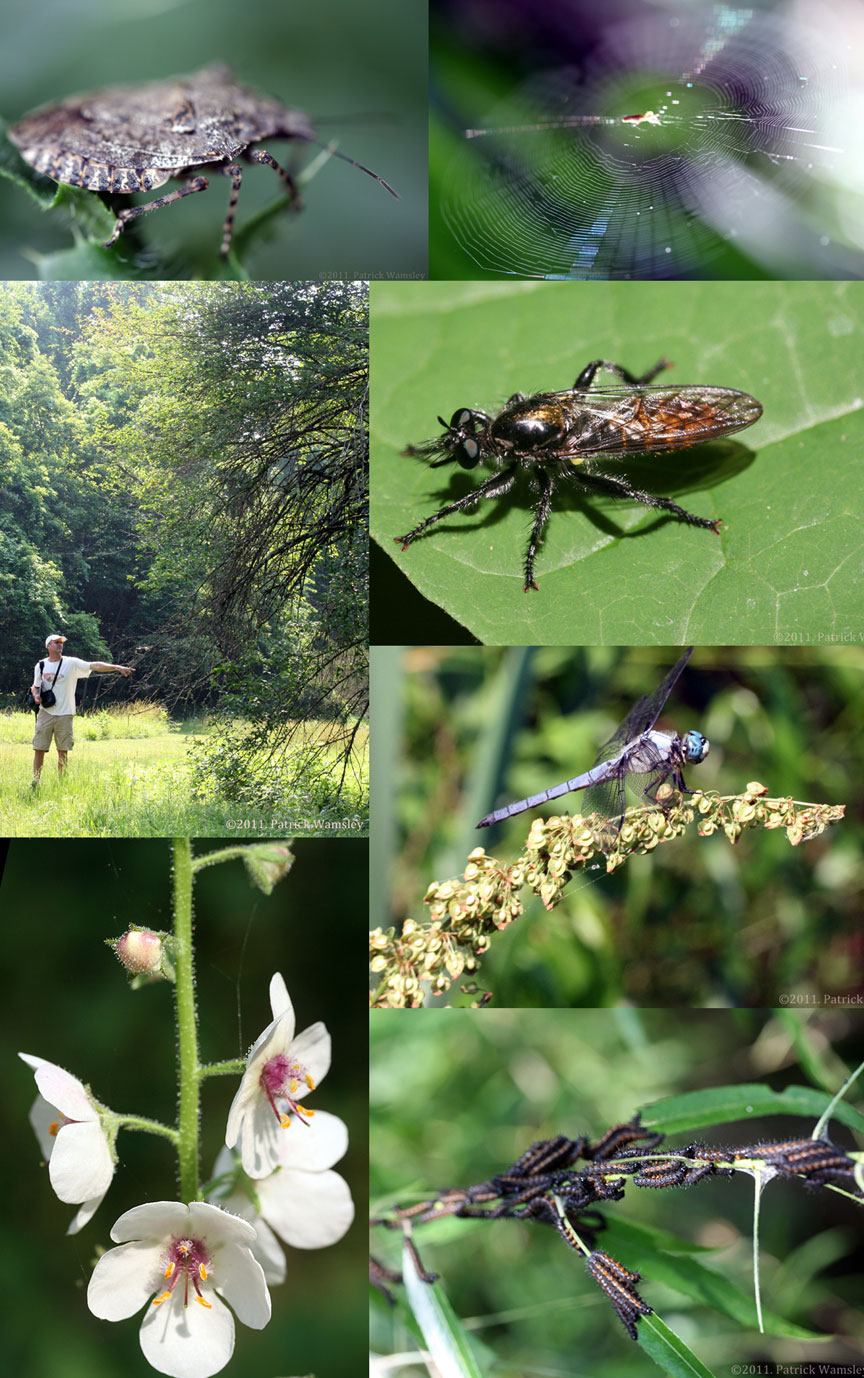 Saturday’s walk, led by Devin Floyd (president of the Blue Ridge Discovery Center) consisted of a two-hour expedition exploring habitat diversity at the Secluded Farm tract. The farm includes nearly 150 acres of field lands and forest, containing a wealth of flora and fauna. The trails and property, which link to the Monticello trails, are maintained by Monticello through a lease from the Thomas Jefferson Soil and Water Conservation District.
Collage to the right © Patrick Wamsley.
List of species observed on the hike: LINK
 The adventure began with some exploration of the rainwater retaining pools at Kemper Park. A bit of mucking about with a net produced tadpoles, dragonfly larvae, and backswimmers! Participants learned about the catalpa hornworm and its reliance on the catalpa tree as its sole food source as well as its importance for fishing enthusiasts.
 Hikers first passed through a variety of open areas, including fields of wingstem, milkweed and dogbane. The concept of “eco-tones” in creating diversity was discussed and the many ways humans create eco-tones.
 Devin took everyone back in time from the Pleistocene era when megafauna such as wooly mammoths and giant sloths roamed between the hawthorns, pawpaw, and honeylocusts, up to when the land was cleared and farmed well into the 20th Century. On the way through the fields the group came upon the national record specimen of a black haw viburnum and pondered why it had survived for so long in a field that had been cut and farmed. Black Haw information sheet
 The hike took the group through two distinctly different forests (oak-hickory and ash-poplar) and Devin challenged the group to formulate hypotheses about why the differences existed, whether it is the aspect of the land, soil chemistry, availability of water, or the age of the forest. He also discussed what forest succession is and why a tree falling in the woods isn’t all that bad.
 Some of the other tree and shrub species the group learned to identify were: slippery elm, tulip poplar, sassafras, honey locust, black walnut, butternut, and spicebush.
 A variety of insect species accompanied the hike including: great spangled fritillary, zebra swallowtail, question mark butterfly, Hercules beetle, and bird species such as the scarlet tanager, titmouse, and yellow-billed cuckoo, among others. It was a great day for walking, exploring, and learning!
 Collage above © Patrick Wamsley

- List of species observed on this hike: LINK
- Paleo Pollen Mapping: http://www.ncdc.noaa.gov/paleo/pollen/viewer/webviewer.html
- Extinction and the importance of history and dependence in conservation: http://www.tc-biodiversity.org/sample-extinction.pdf
- Flora of the Southern and Mid-Atlantic States (large pdf): http://www.herbarium.unc.edu/WeakleyFlora2010Mar.pdf
